
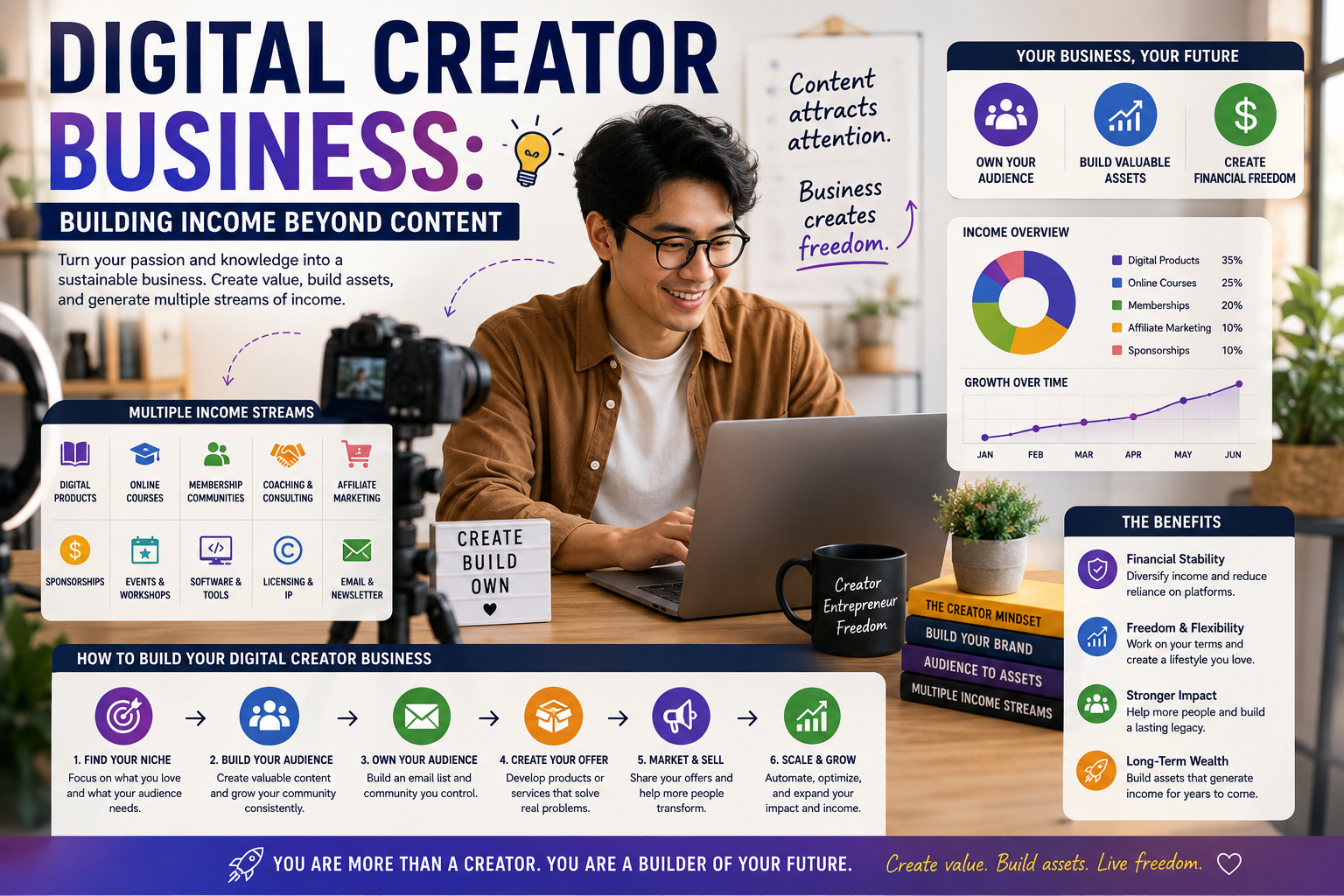
Digital Creator Business: Building Income Beyond Content – The creator economy has evolved dramatically over the past decade. What began as a world dominated by bloggers, YouTubers, and social media influencers has transformed into a sophisticated ecosystem where creators are building real businesses, generating multiple income streams, and creating long-term wealth.
In 2026, successful creators are no longer relying solely on views, likes, sponsorships, or advertising revenue. Instead, they are building digital creator businesses—scalable enterprises that extend far beyond content creation.
This shift is changing how creators approach growth, monetization, and sustainability. Content remains important, but it is increasingly becoming a tool for attracting audiences rather than the primary source of income.
The most successful creators are learning a powerful lesson: content attracts attention, but businesses generate long-term value.
What Is a Digital Creator Business?
A digital creator business is a business built around a creator’s expertise, audience, brand, and intellectual property.
Unlike traditional influencers who primarily earn income from sponsorships or advertisements, creator entrepreneurs develop multiple revenue streams that can operate independently of social media algorithms.
These businesses often include:
- Digital products
- Online courses
- Membership communities
- Consulting services
- Coaching programs
- Affiliate marketing
- Subscription platforms
- Software products
- Licensing agreements
- Creator-owned brands
Content serves as the marketing engine that attracts and nurtures audiences, while the business generates revenue through products and services.
This model creates greater stability and scalability than relying solely on platform monetization.
Why Content Alone Is No Longer Enough
For many years, creators focused heavily on audience growth.
More followers typically meant more views, sponsorship opportunities, and advertising income.
However, several challenges have emerged:
Algorithm Dependence
Social media platforms constantly adjust their algorithms.
A creator’s reach can increase or decrease dramatically without warning.
Growing Competition
Millions of creators now compete for attention online.
Standing out is becoming increasingly difficult.
Advertising Volatility
Advertising rates fluctuate based on market conditions, seasonality, and platform policies.
Platform Risk
A creator does not own their followers on social media.
If a platform changes its rules or loses popularity, creators may lose access to their audience.
These realities have encouraged many creators to move beyond content-based monetization and build more sustainable businesses.
The Rise of Creator Entrepreneurship
The most successful creators today think like entrepreneurs.
Rather than asking:
“How can I get more views?”
They ask:
“How can I create more value?”
This shift changes everything.
Instead of focusing solely on audience size, creator entrepreneurs focus on solving problems, building relationships, and developing products that meet specific needs.
Content becomes the first step in a larger customer journey.
A video, article, or social media post introduces someone to the creator’s expertise.
From there, the audience may join an email list, purchase a product, enroll in a course, or become part of a community.
This business-focused approach creates significantly more opportunities for growth.
Building an Owned Audience
One of the most important trends in the creator economy is audience ownership.
Social media followers are valuable, but they remain controlled by the platforms where they exist.
Successful creator businesses prioritize owned channels such as:
Email Newsletters
Email remains one of the most effective tools for direct communication.
Creators can reach subscribers without relying on algorithms.
Membership Communities
Private communities allow creators to build deeper relationships and recurring revenue.
Personal Websites
A website serves as a central hub for products, content, and audience engagement.
Customer Databases
Building direct customer relationships creates long-term business value.
Owned audiences provide stability and greater control over growth strategies.
Creating Digital Creator Business Products
Digital products are among the most profitable assets creators can develop.
Unlike physical products, digital products have minimal production and distribution costs.
Popular examples include:
- E-books
- Templates
- Guides
- AI prompts
- Design resources
- Worksheets
- Notion systems
- Spreadsheets
- Toolkits
- Educational materials
Once created, these products can be sold repeatedly without significant additional effort.
Many creators discover that a single successful digital product generates more revenue than months of advertising income.
Online Courses as a Business Model
Online education continues to be one of the fastest-growing areas of the creator economy.
People are willing to pay for knowledge that helps them:
- Improve skills
- Advance careers
- Increase income
- Save time
- Solve specific problems
Creators who possess expertise in a particular area can package their knowledge into structured learning experiences.
Successful courses focus on outcomes rather than information.
Students are not paying for content alone.
They are paying for transformation.
This distinction is crucial when building educational products.
Membership Communities and Recurring Revenue
Many creators are shifting toward recurring revenue models.
Membership communities allow creators to earn predictable monthly income while delivering ongoing value.
Common membership benefits include:
- Exclusive content
- Private forums
- Live workshops
- Group coaching
- Networking opportunities
- Early access to resources
- Premium educational content
Recurring revenue provides financial stability and reduces pressure to constantly chase viral content.
It also strengthens audience relationships by encouraging ongoing engagement.
Affiliate Marketing Beyond Sponsorships
Affiliate marketing remains one of the most accessible monetization strategies.
However, successful creators treat affiliate marketing differently than traditional advertising.
Rather than promoting random products, they recommend tools and services that genuinely help their audience.
Strong affiliate marketing is built on:
- Trust
- Transparency
- Expertise
- Relevance
When recommendations align with audience needs, affiliate income can become a significant revenue stream.
This model is especially effective in technology, software, finance, productivity, and education niches.
Leveraging AI for Business Growth
Artificial intelligence is transforming the creator economy.
Creators now use AI tools to:
- Generate ideas
- Conduct research
- Draft content
- Edit videos
- Create graphics
- Analyze performance
- Automate workflows
- Improve customer support
AI enables creators to operate more efficiently and scale faster.
However, successful creators understand that AI is a tool rather than a replacement for expertise.
Authenticity remains one of the most important competitive advantages.
The creators who combine AI efficiency with genuine human insights are positioned for long-term success.
Developing a Personal Brand
A strong personal brand is one of the most valuable assets a creator can build.
People often purchase products because they trust the creator behind them.
Personal branding involves:
- Consistent messaging
- Clear positioning
- Authentic communication
- Demonstrated expertise
- Community engagement
Trust acts as the bridge between audience attention and business revenue.
Without trust, even the best products struggle to succeed.
With trust, creators can launch new products, services, and initiatives more effectively.
Diversifying Revenue Streams
One of the defining characteristics of successful creator businesses is diversification.
Rather than relying on a single source of income, creators build multiple revenue channels.
Examples include:
- Advertising revenue
- Affiliate commissions
- Digital products
- Online courses
- Memberships
- Sponsorships
- Consulting services
- Coaching programs
- Events
- Licensing agreements
Diversification reduces risk and increases financial stability.
When one revenue stream slows down, others can continue generating income.
This approach creates a stronger and more resilient business.
Common Mistakes Creators Make
Many creators struggle to transition from content creation to business building.
Common mistakes include:
Focusing Only on Followers
Large audiences do not automatically translate into revenue.
Delaying Monetization
Waiting too long to develop products can slow business growth.
Ignoring Audience Needs
Successful businesses solve real problems.
Over-Reliance on One Platform
Diversification protects against algorithm changes.
Neglecting Relationships
Strong communities often outperform large passive audiences.
Avoiding these mistakes can significantly accelerate business growth.
The Future of Digital Creator Business
The future of the creator economy is moving toward ownership, entrepreneurship, and sustainability.
Creators are increasingly becoming:
- Educators
- Entrepreneurs
- Product builders
- Community leaders
- Media company founders
Rather than depending entirely on external platforms, they are creating assets that generate long-term value.
As AI continues to improve productivity, creators will have more opportunities to focus on strategy, relationships, and innovation.
The distinction between creator and business owner will continue to blur.
In many cases, the most successful creators will be those who build businesses first and content second.
Conclusion
The era of relying solely on content for income is rapidly coming to an end.
In 2026, successful creators are building digital creator businesses that generate revenue through products, services, communities, and intellectual property.
Content remains essential, but it serves a larger purpose: attracting audiences, building trust, and creating opportunities for deeper engagement.
Creators who focus on ownership, diversification, audience relationships, and long-term value will be best positioned for sustainable growth.
The future belongs not just to content creators, but to creator entrepreneurs who understand how to turn attention into assets and audiences into thriving businesses.