Creator Economy Trends 2026: From Reach to Ownership – The creator economy has entered a new era. For years, creators focused on maximizing reach, growing follower counts, and chasing viral moments across social media platforms. Success was often measured by views, likes, shares, and subscriber growth.
In 2026, however, the landscape is changing.
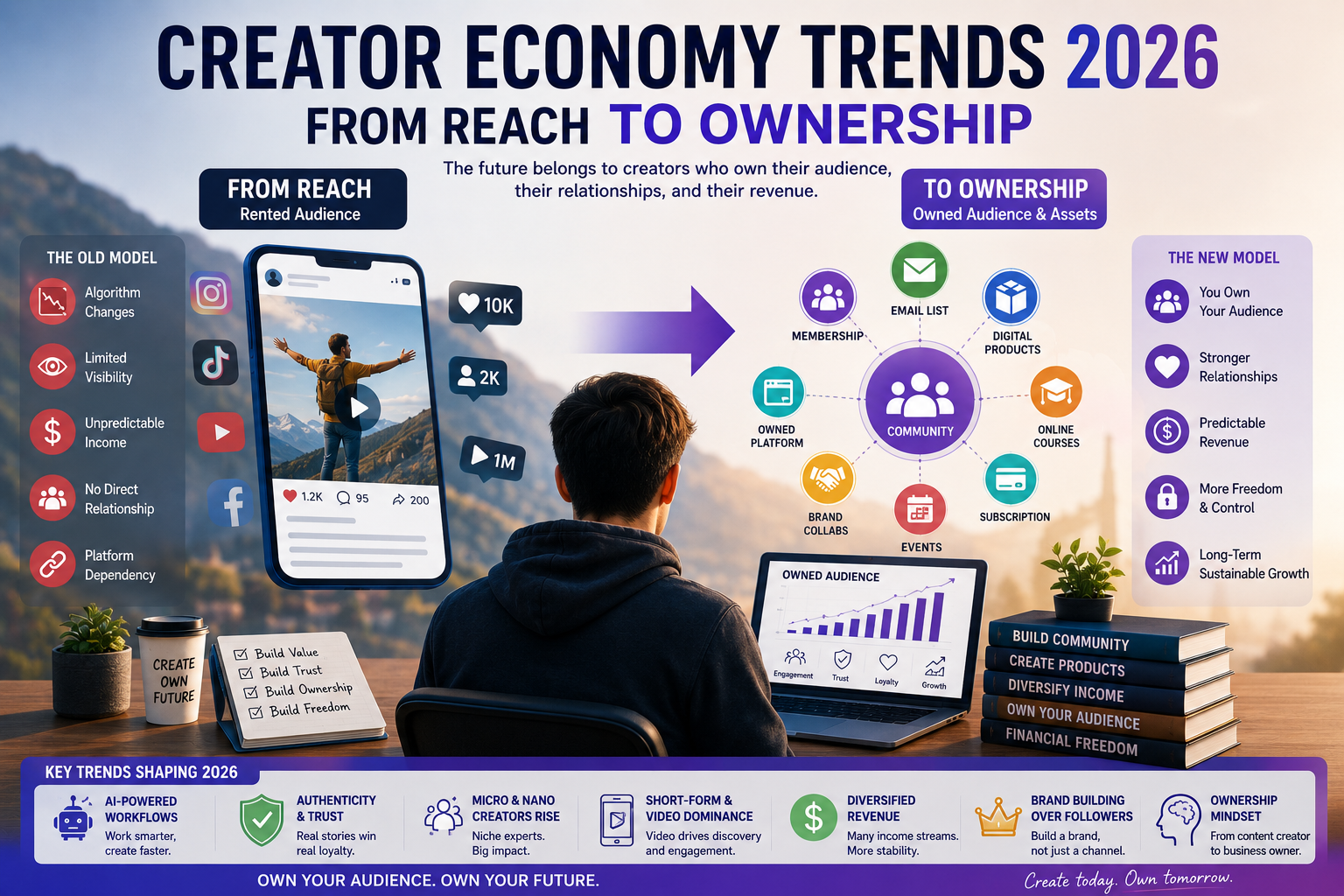
While audience growth remains important, creators are increasingly prioritizing ownership over reach. Instead of relying entirely on platform algorithms, they are building assets they control, including email lists, membership communities, digital products, intellectual property, and direct audience relationships.
This shift represents one of the most significant developments in the modern creator economy. The creators who thrive in 2026 are not simply attracting attention—they are transforming attention into sustainable businesses.
The Creator Economy Has Matured
The creator economy is no longer an emerging trend. It has become a major part of the global digital economy, with hundreds of millions of creators participating worldwide. At the same time, competition has intensified, making it harder than ever to stand out through content alone.
As more creators enter the market, follower growth alone is no longer enough to guarantee long-term success.
The most successful creators are evolving from content producers into business owners. They are building brands, developing products, and creating ecosystems that extend beyond social media platforms.
This transformation is reshaping how creators think about growth, monetization, and audience relationships.
The Shift From Reach to Ownership
For much of the social media era, creators focused on rented audiences.
A creator might have millions of followers on a platform, but ultimately the platform controls access to those followers through algorithms and policy changes.
This creates significant risk.
Algorithms can change overnight. Organic reach can decline. Monetization programs can be modified or removed. Entire platforms can lose popularity.
As a result, ownership has become a central theme in 2026. Industry reports consistently identify owned audiences, platform diversification, and direct relationships as some of the most important creator trends of the year.
Ownership means building assets that remain under the creator’s control regardless of platform changes.
Examples include:
- Email newsletters
- Membership communities
- Websites
- Digital products
- Online courses
- Intellectual property
- Private communities
- Subscription businesses
These assets create stability and reduce dependence on third-party platforms.
Why Owned Audiences Matter More Than Ever
One of the biggest challenges creators face today is declining visibility.
Many platforms have shifted from follower-based distribution to interest-based recommendation systems. While these algorithms can help creators reach new audiences, they can also limit access to existing followers.
In practice, having followers does not guarantee those followers will see future content.
This challenge has become even more pronounced as AI-generated content increases content volume across digital platforms. Many creators now view owned audiences as essential protection against growing algorithmic uncertainty.
An email subscriber, community member, or paying customer represents a direct relationship that cannot be easily disrupted by algorithm changes.
As a result, creators are investing more heavily in audience ownership than ever before.
AI Is Reshaping Creator Workflows
Artificial intelligence has become one of the defining trends of the creator economy in 2026.
AI tools now assist creators with:
- Research
- Script writing
- Editing
- Image generation
- Video production
- Content planning
- Analytics
- Customer support
According to a large global creator survey, the vast majority of creators using AI report that it helps grow their businesses and audiences, while many now consider AI an essential part of their workflows.
However, creators are also emphasizing the importance of maintaining human control over creative decisions.
AI is increasingly viewed as a productivity tool rather than a replacement for creativity.
The creators who succeed are those who combine AI efficiency with authentic human perspectives and experiences.
Authenticity Becomes a Competitive Advantage
As AI-generated content becomes more common, authenticity is becoming more valuable.
Audiences are increasingly seeking genuine voices, personal experiences, and meaningful connections.
Industry research suggests that human-created content is becoming a premium asset in the AI era, with creators and audiences placing greater value on originality, transparency, and emotional connection.
This trend is encouraging creators to focus less on volume and more on quality.
Instead of publishing endless content to satisfy algorithms, many are prioritizing:
- Personal storytelling
- Community engagement
- Behind-the-scenes content
- Educational value
- Authentic experiences
Trust is emerging as one of the strongest growth drivers in the creator economy.
Diversified Revenue Is Replacing Platform Dependence
Another major trend in 2026 is revenue diversification.
Many creators have learned that relying solely on advertising or sponsorships can be risky.
Successful creators are increasingly generating income from multiple sources, including:
- Affiliate marketing
- Digital products
- Membership programs
- Online courses
- Coaching
- Consulting
- Licensing
- Events
- Subscription services
This diversification creates greater financial stability.
Instead of depending on a single platform or revenue source, creators build business models that can withstand industry changes.
The focus is shifting from audience size to business sustainability.
Community Is Becoming the New Growth Engine
Follower counts remain visible metrics, but community engagement is becoming more important.
Brands and creators alike are recognizing that highly engaged communities often generate greater long-term value than large passive audiences.
Many creators are building:
- Discord communities
- Membership groups
- Private forums
- Exclusive newsletters
- Paid communities
These spaces encourage deeper relationships and stronger audience loyalty.
Community members often become customers, advocates, collaborators, and long-term supporters.
The creator economy is increasingly moving toward relationship-based growth rather than purely algorithmic growth.
The Rise of Creator-Owned Brands
One of the most exciting trends in 2026 is the rise of creator-owned businesses.
Rather than serving solely as influencers promoting other companies, creators are launching their own products and brands.
Examples include:
- Apparel brands
- Educational platforms
- Software products
- Wellness products
- Media companies
- Consumer goods
- Subscription services
This trend reflects a broader shift toward ownership.
Creators are increasingly interested in building equity rather than relying exclusively on sponsorship income.
The goal is to create assets that appreciate in value over time.
In many cases, creators are evolving into entrepreneurs and media company founders.
Professionalization of the Creator Economy
The creator economy is becoming more professional.
Top creators increasingly operate like small businesses rather than solo content producers.
Teams now commonly include:
- Editors
- Researchers
- Designers
- Community managers
- Business operators
- Marketing specialists
Many creators are developing repeatable systems and long-term business strategies.
Industry observers frequently describe the creator economy’s next phase as a transition from individual creators to creator-led media companies.
This professionalization is creating new opportunities while raising standards across the industry.
Retention Is Replacing Virality
For years, viral content dominated creator strategy.
Today, retention is becoming a more important metric.
Creators increasingly ask:
- How many subscribers stay engaged?
- How many customers return?
- How many members renew subscriptions?
- How strong is audience loyalty?
Industry reports identify a growing shift from reach-focused strategies to retention-focused growth.
A smaller but highly engaged audience often produces better business outcomes than a massive audience with little loyalty.
This change is influencing content strategies, community-building efforts, and monetization models across the creator economy.
What Creators Should Focus on in 2026
To succeed in the evolving creator economy, creators should prioritize:
- Building owned audiences through email and communities.
- Diversifying revenue streams.
- Using AI to improve productivity while maintaining authenticity.
- Developing intellectual property and proprietary products.
- Strengthening audience relationships.
- Creating long-term business assets.
- Focusing on retention rather than vanity metrics.
- Building systems that reduce dependence on algorithms.
These strategies help transform content creation from a short-term activity into a sustainable business.
Conclusion
The biggest creator economy trend of 2026 can be summarized in a single phrase: from reach to ownership.
Creators are moving beyond the pursuit of followers and views toward building businesses, communities, products, and direct audience relationships. AI is accelerating productivity, but authenticity remains a key differentiator. Revenue diversification is replacing platform dependence, while audience ownership is becoming the foundation of long-term success.
The future belongs to creators who treat content as more than a distribution tool. It belongs to those who build assets, cultivate trust, and create lasting relationships with the audiences they serve.
In the next phase of the creator economy, ownership—not reach—will be the ultimate competitive advantage.