
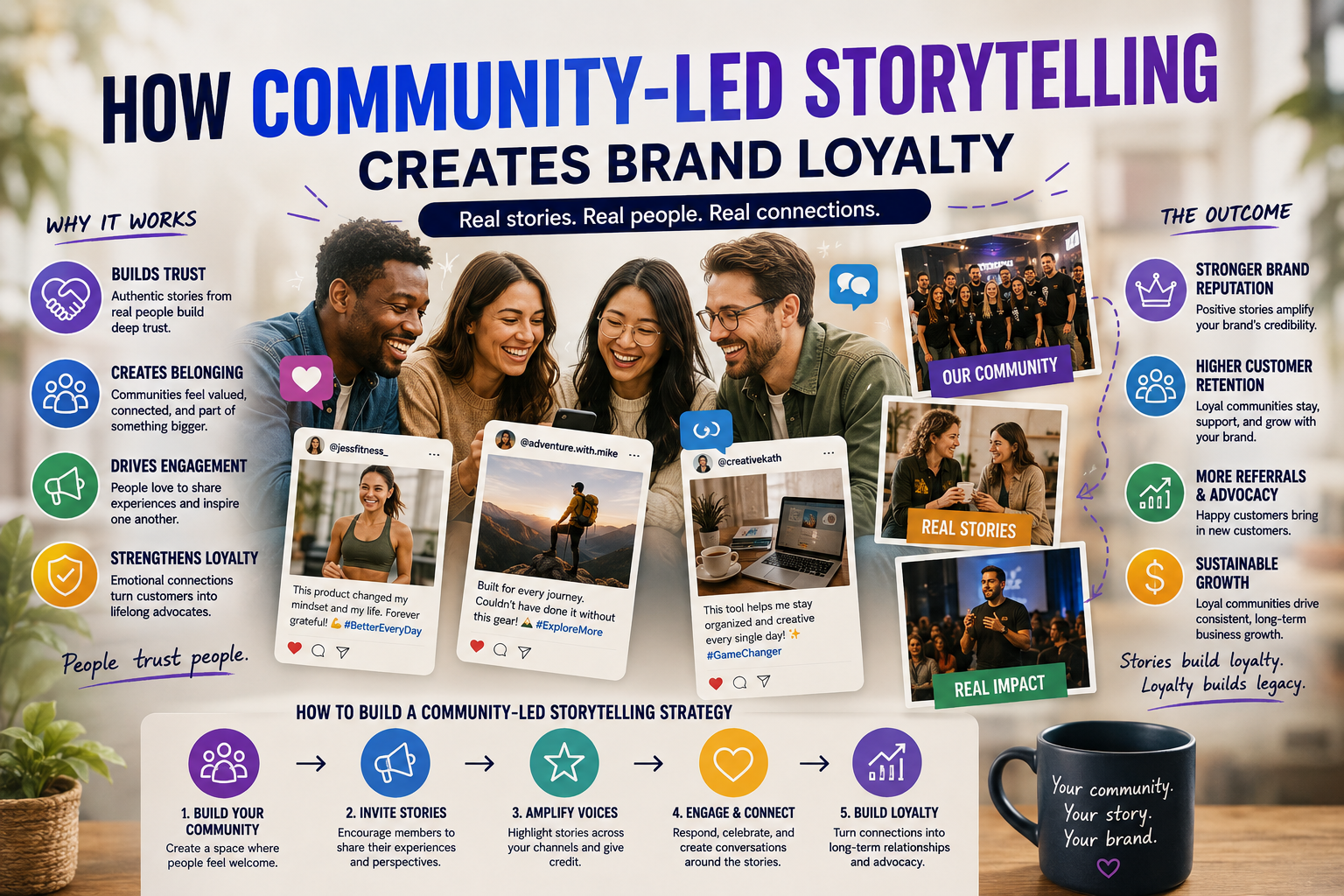
How Community-Led Storytelling Creates Brand Loyalty – In an increasingly crowded digital marketplace, brands face a growing challenge: earning and maintaining customer loyalty. Consumers today have countless options, easy access to information, and the ability to switch brands with just a few clicks. Traditional advertising alone is no longer enough to create lasting relationships.
Modern consumers want more than products and services. They want connection, authenticity, and shared values. This shift has led many organizations to embrace community-led storytelling as a powerful strategy for building trust and long-term loyalty.
Rather than relying solely on carefully crafted marketing messages, community-led storytelling allows customers, fans, and members to become active participants in a brand’s narrative. Their experiences, successes, challenges, and voices help shape the story that surrounds the brand.
As a result, customers feel more connected, valued, and invested in the brand’s success.
What Is Community-Led Storytelling?
Community-led storytelling is the practice of involving customers, users, fans, employees, or community members in creating and sharing stories related to a brand.
Instead of controlling every message, brands provide opportunities for their communities to contribute experiences, insights, testimonials, and content.
Examples include:
- User-generated content campaigns
- Customer success stories
- Community forums
- Social media challenges
- Member spotlights
- Brand ambassador programs
- Community events
- Collaborative storytelling projects
In this approach, the community becomes an essential part of the brand’s identity rather than simply an audience consuming content.
Why Storytelling Matters for Brand Loyalty
Humans naturally connect through stories.
Stories help people understand experiences, share emotions, and create meaning. While product features and specifications may influence purchasing decisions, stories often determine how people feel about a brand.
A compelling story can:
- Create emotional connections
- Build trust
- Increase engagement
- Improve brand recall
- Strengthen customer relationships
When customers feel emotionally connected to a brand, they are more likely to remain loyal even when competitors offer similar products or lower prices.
Storytelling transforms transactions into relationships.
The Shift From Brand-Centric to Community-Centric Marketing
Traditional marketing focuses on broadcasting messages from the company to consumers.
The brand controls the narrative and communicates its values, products, and achievements.
However, today’s audiences are increasingly skeptical of purely promotional content.
Consumers trust recommendations, reviews, and real experiences from other people more than traditional advertising.
Community-led storytelling reflects this shift.
Instead of saying, “Our product is great,” brands create spaces where customers can share why the product has positively impacted their lives.
The message becomes more authentic because it comes directly from the community.
This authenticity is one of the strongest drivers of modern brand loyalty.
Authenticity Builds Trust
Trust is the foundation of loyalty.
Customers are more likely to trust stories shared by fellow consumers because these experiences feel genuine and relatable.
When community members openly discuss how a product solved a problem, improved their lives, or helped them achieve a goal, the story carries more credibility than a traditional advertisement.
Authentic storytelling demonstrates transparency.
It shows that a brand is confident enough to allow real customers to speak on its behalf.
This openness creates stronger trust and encourages deeper engagement.
In a digital environment where consumers are constantly exposed to marketing messages, authenticity stands out.
Creating a Sense of Belonging
One of the most powerful aspects of community-led storytelling is its ability to create a sense of belonging.
People naturally seek communities where they feel understood, appreciated, and connected.
Brands that foster active communities often become more than commercial entities. They become platforms for shared interests, values, and experiences.
For example, fitness brands may create communities where members share personal transformation stories.
Technology brands may encourage users to showcase innovative projects built with their products.
Educational platforms may highlight student success stories.
These narratives help members see themselves as part of something larger than a simple customer relationship.
The stronger the sense of belonging, the stronger the loyalty.
User-Generated Content Strengthens Engagement
User-generated content is one of the most effective forms of community-led storytelling.
When customers create content related to a brand, they become active participants rather than passive consumers.
Examples include:
- Product reviews
- Social media posts
- Testimonials
- Photos and videos
- Tutorials
- Case studies
- Community discussions
This content not only increases engagement but also expands the brand’s reach.
Potential customers often view user-generated content as more trustworthy than traditional promotional material.
Furthermore, community members feel recognized and appreciated when their contributions are highlighted by the brand.
This recognition strengthens emotional connections and encourages continued participation.
Turning Customers Into Brand Advocates
Loyal customers are valuable.
Brand advocates are even more powerful.
Advocates voluntarily recommend products, defend brands during criticism, and encourage others to join the community.
Community-led storytelling helps transform satisfied customers into passionate advocates.
When people share their personal experiences, they become emotionally invested in the brand narrative.
Their stories contribute to the community’s identity.
As a result, they often feel a stronger sense of ownership and pride in the brand’s success.
Advocacy becomes a natural extension of their involvement.
This organic promotion is often more effective than paid advertising because it comes from genuine enthusiasm.
Community Stories Provide Social Proof
Social proof plays a major role in consumer decision-making.
People frequently look to others for guidance before making purchases.
Community-led storytelling generates powerful social proof by showcasing real experiences and outcomes.
A potential customer may trust dozens of customer stories more than a single marketing campaign.
Stories demonstrate how products perform in real-world situations.
They help prospects visualize their own success and reduce uncertainty.
As more community members contribute stories, the brand builds a growing collection of evidence that reinforces trust and credibility.
Building Long-Term Relationships
Many marketing strategies focus on short-term conversions.
Community-led storytelling focuses on long-term relationships.
When brands continuously engage community members and encourage participation, customers remain connected long after the initial purchase.
Regular storytelling opportunities keep conversations active.
Community members return to:
- Share experiences
- Celebrate milestones
- Learn from others
- Support fellow members
- Participate in discussions
These ongoing interactions strengthen relationships over time.
Loyalty becomes rooted in connection rather than convenience.
The Role of Social Media in Community Storytelling
Social media platforms have become powerful environments for community-led storytelling.
Platforms such as Instagram, TikTok, Facebook, LinkedIn, YouTube, and Discord allow brands and communities to interact in real time.
Successful brands often encourage storytelling through:
- Hashtag campaigns
- Community challenges
- Customer spotlights
- Live events
- Interactive discussions
- Collaborative content
These activities create opportunities for community members to contribute their voices while increasing visibility and engagement.
The result is a dynamic ecosystem where storytelling continuously evolves through community participation.
Community-Led Storytelling in the AI Era
Artificial intelligence is changing the way content is created and distributed.
While AI can generate content efficiently, community-led storytelling offers something technology cannot fully replicate: authentic human experience.
AI can assist with content management, moderation, personalization, and analysis.
However, the stories themselves remain most powerful when they come from real people.
In the AI era, authentic community experiences may become even more valuable because audiences increasingly seek genuine human connections.
Brands that successfully combine technology with human-centered storytelling will have a significant advantage.
Best Practices for Community-Led Storytelling
Organizations seeking to build loyalty through community storytelling should consider several key practices:
Encourage Participation
Make it easy for community members to share experiences and ideas.
Highlight Diverse Voices
Feature stories from different backgrounds and perspectives.
Celebrate Community Success
Recognize achievements and contributions publicly.
Maintain Authenticity
Avoid over-editing or controlling community narratives.
Foster Meaningful Conversations
Encourage dialogue rather than one-way communication.
Align Stories With Brand Values
Ensure community stories reinforce the mission and purpose of the brand.
Create Ongoing Opportunities
Build storytelling into regular community activities.
Conclusion
Community-led storytelling has emerged as one of the most effective strategies for building brand loyalty in the digital age.
By empowering customers and community members to share their experiences, brands create authentic narratives that foster trust, engagement, and emotional connection.
Unlike traditional advertising, community-led storytelling transforms customers into active participants and advocates. It strengthens belonging, generates social proof, and creates long-term relationships that extend far beyond individual transactions.
As consumers continue to seek authenticity and meaningful connections, brands that embrace community-driven narratives will be better positioned to build loyal audiences and sustainable growth.
In the end, the most powerful brand stories are often not the ones companies tell about themselves—they are the stories communities tell about each other.