
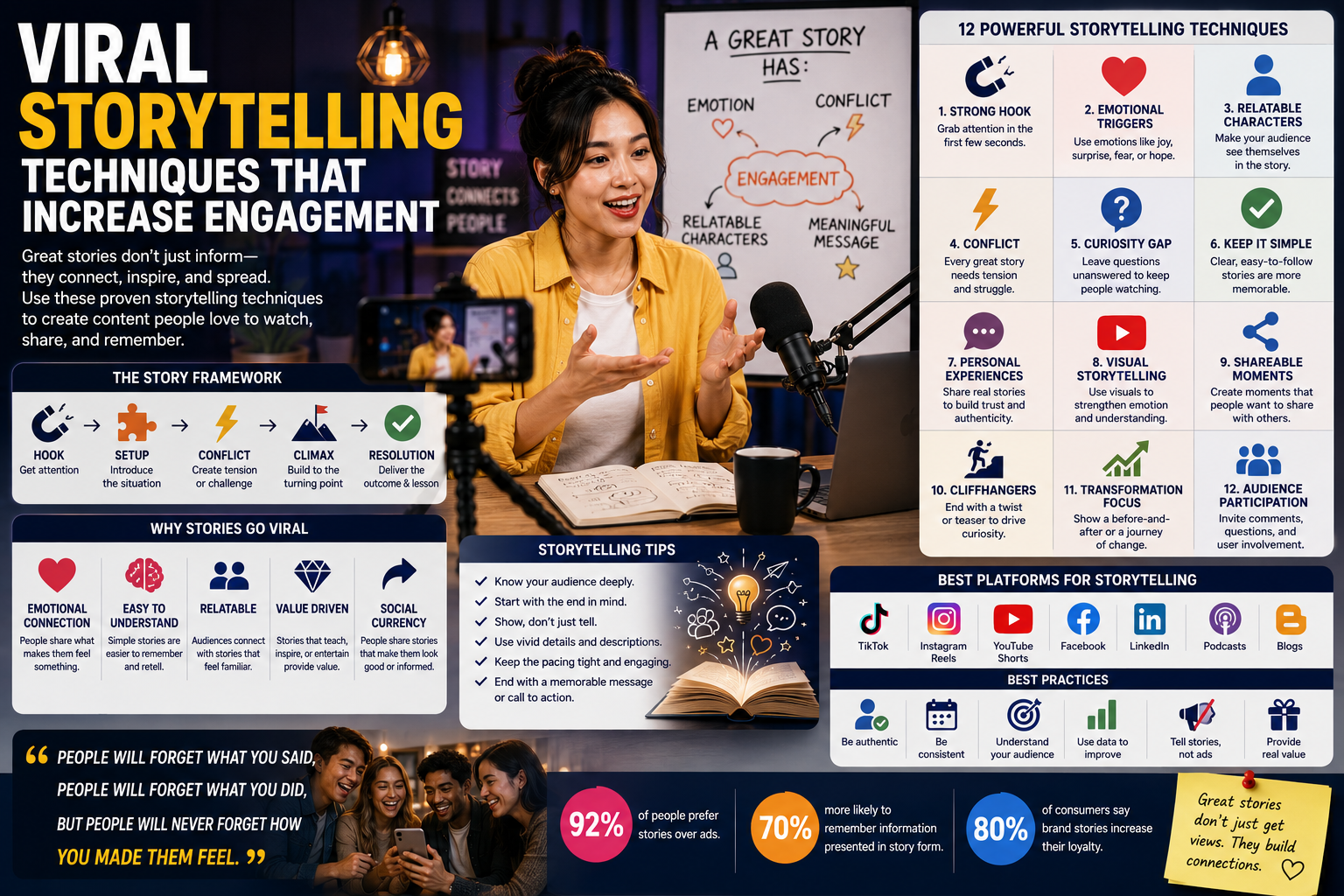
Viral Storytelling Techniques That Increase Engagement – In the crowded digital landscape of 2026, creating content is easier than ever. With AI-powered tools, social media platforms, and affordable content production software, millions of creators and brands publish new content every day. The challenge is no longer creating content—it is getting people to pay attention.
Audiences scroll through endless streams of videos, articles, images, and posts. Most content is ignored within seconds. Yet some stories break through the noise, capture attention, spark conversations, and spread rapidly across platforms.
What makes these stories different?
The answer often lies in the use of effective Viral Storytelling Techniques. Viral content is rarely accidental. While no strategy can guarantee virality, successful stories often follow specific storytelling principles that increase engagement, emotional connection, and shareability.
Understanding these techniques can help creators, marketers, and businesses create content that resonates more deeply with audiences and encourages widespread participation.
Why Storytelling Drives Engagement
Humans are naturally drawn to stories.
Long before the internet existed, stories were used to share knowledge, entertain communities, preserve culture, and build relationships. Storytelling remains one of the most powerful forms of communication because it helps people understand information through emotion and experience.
Stories are memorable because they:
- Create emotional connections
- Simplify complex ideas
- Capture attention
- Inspire action
- Encourage sharing
When content includes a compelling narrative, audiences become invested in the outcome.
This emotional investment often leads to higher engagement rates, longer watch times, and increased social sharing.
Start With a Powerful Hook
One of the most important viral storytelling techniques is creating a strong opening.
Modern audiences decide within seconds whether to continue consuming content.
A weak introduction can cause viewers to scroll away immediately.
Effective hooks often include:
- Surprising facts
- Intriguing questions
- Unexpected situations
- Bold statements
- Emotional moments
For example:
- “I lost my entire business in one day.”
- “This mistake cost me $100,000.”
- “Nobody believed this would work.”
These openings create curiosity and encourage audiences to continue watching or reading.
A compelling hook is often the difference between content that gets ignored and content that gains traction.
Use Emotional Triggers
Emotion is one of the strongest drivers of engagement.
People are far more likely to remember and share content that makes them feel something.
Common emotional triggers include:
Inspiration
Stories of achievement, growth, and perseverance.
Surprise
Unexpected twists and revelations.
Joy
Humor, positivity, and uplifting moments.
Empathy
Personal struggles and relatable experiences.
Hope
Transformation and possibility.
Curiosity
Information gaps that encourage further exploration.
Emotional storytelling creates stronger audience connections and increases the likelihood of social sharing.
People often share content because they want others to experience the same emotions.
Create Relatable Characters
Every strong story needs a central figure.
In digital content, this may be:
- The creator
- A customer
- An employee
- A community member
- A fictional character
Audiences engage more deeply when they can identify with someone in the story.
Relatable characters often possess:
- Realistic challenges
- Authentic motivations
- Personal flaws
- Meaningful goals
Perfect characters are often less engaging than imperfect ones.
People connect with struggles because they reflect real-life experiences.
When audiences see themselves in the story, engagement naturally increases.
Build Tension and Conflict
Conflict is the engine of storytelling.
Without conflict, stories often feel flat and uninteresting.
Conflict creates uncertainty and motivates audiences to seek resolution.
Examples include:
- Overcoming obstacles
- Solving problems
- Facing competition
- Navigating difficult decisions
- Pursuing ambitious goals
Conflict does not need to be dramatic.
Even small challenges can create narrative momentum.
The key is presenting a situation that raises questions in the audience’s mind.
People continue watching because they want to know what happens next.
Use the Curiosity Gap
One of the most effective viral storytelling techniques is creating a curiosity gap.
A curiosity gap occurs when audiences know enough to become interested but not enough to satisfy their curiosity.
Examples include:
- “The secret strategy nobody talks about.”
- “What happened next surprised everyone.”
- “This simple change transformed everything.”
The goal is not to mislead audiences but to encourage continued engagement.
Effective curiosity gaps provide genuine value once the answer is revealed.
When used correctly, this technique increases watch time and content completion rates.
Keep Stories Simple
Many creators make the mistake of overcomplicating their narratives.
Viral stories are often surprisingly simple.
The audience should immediately understand:
- Who the story is about
- What the challenge is
- Why it matters
- What outcome is at stake
Complex stories require more effort to follow.
Simple stories are easier to consume, remember, and share.
Clarity is particularly important in short-form content where attention spans are limited.
The most engaging stories often focus on a single core message.
Leverage Personal Experiences
Personal stories consistently perform well because they feel authentic.
Audiences increasingly value genuine experiences over generic information.
Personal storytelling may include:
- Lessons learned
- Business failures
- Career journeys
- Personal transformations
- Unexpected discoveries
These stories provide unique perspectives that cannot easily be replicated.
Authenticity strengthens trust and makes content more memorable.
In an era where AI-generated content is becoming increasingly common, genuine personal experiences are a powerful differentiator.
Incorporate Visual Storytelling
Visual elements play a major role in engagement.
Images, videos, animations, and graphics can communicate information more quickly than text alone.
Effective visual storytelling includes:
- Strong imagery
- Dynamic video editing
- Clear visual progression
- Emotional facial expressions
- Relevant supporting visuals
Visual cues help audiences understand the narrative while maintaining attention.
This is especially important on platforms such as TikTok, YouTube Shorts, Instagram Reels, and Facebook Reels.
Create Shareable Moments
Viral content often contains moments that audiences feel compelled to share.
These moments may be:
- Inspiring
- Surprising
- Educational
- Entertaining
- Thought-provoking
Ask yourself:
“Would someone want to send this to a friend?”
If the answer is yes, the content has stronger viral potential.
Shareability increases when stories provide social value.
People share content that reflects their interests, beliefs, identity, or sense of humor.
Use Cliffhangers and Open Loops
Cliffhangers are not limited to television shows.
They are highly effective in digital storytelling.
An open loop occurs when a question remains unanswered temporarily.
Examples include:
- “But then something unexpected happened.”
- “The biggest challenge was still ahead.”
- “That was only the beginning.”
Open loops create anticipation and encourage audiences to continue consuming content.
This technique is particularly effective in video series, newsletters, podcasts, and multi-part content campaigns.
Focus on Transformation
Transformation is one of the most engaging story structures.
Audiences enjoy seeing change and progress.
Popular transformation narratives include:
- Before and after results
- Skill development
- Personal growth
- Business success
- Health improvements
- Creative breakthroughs
Transformation provides a clear narrative arc.
The audience witnesses movement from one state to another.
This progression creates satisfaction and emotional impact.
Encourage Audience Participation
Engagement increases when audiences become part of the story.
Interactive storytelling can include:
- Polls
- Questions
- Challenges
- User-generated content
- Community discussions
Participation transforms passive viewers into active contributors.
People are more invested in content when they feel involved.
Community-driven storytelling also increases reach by encouraging audiences to create and share related content.
Adapt Stories for Different Platforms
Every platform has unique audience behaviors and content formats.
Successful storytellers adapt their approach accordingly.
For example:
TikTok
Fast-paced storytelling with strong hooks.
YouTube
More detailed narratives with deeper explanations.
Instagram Reels
Visually engaging and highly shareable content.
Professional stories focused on insights and lessons.
Newsletters
Personal and relationship-driven storytelling.
Platform-specific optimization improves engagement because it aligns with audience expectations.
Use AI Without Losing Authenticity
AI tools are becoming increasingly important in content creation.
Creators use AI for:
- Research
- Idea generation
- Script drafting
- Editing
- Analytics
However, authenticity remains essential.
Audiences respond best to content that includes genuine human experiences and perspectives.
The most effective strategy is combining AI efficiency with human creativity.
Technology can improve production, but authentic storytelling remains the foundation of engagement.
Common Storytelling Mistakes
Many creators unintentionally reduce engagement by making avoidable mistakes.
Common problems include:
Weak Introductions
Failing to capture attention quickly.
Lack of Emotional Connection
Providing information without creating feelings.
Overcomplicated Narratives
Making stories difficult to follow.
No Clear Resolution
Leaving audiences unsatisfied.
Excessive Promotion
Prioritizing sales over value.
Avoiding these mistakes improves content quality and audience retention.
The Future of Viral Storytelling
As digital platforms continue evolving, storytelling will remain central to audience engagement.
Future trends may include:
- AI-personalized narratives
- Interactive story experiences
- Immersive digital environments
- Community-driven storytelling
- Virtual influencer narratives
Despite technological advances, the core principles of storytelling are unlikely to change.
People will continue seeking stories that inspire, entertain, educate, and connect them with others.
The creators who master these principles will remain competitive regardless of platform changes.
Conclusion
Viral Storytelling Techniques are powerful tools for increasing engagement in an increasingly crowded digital world.
By using strong hooks, emotional triggers, relatable characters, conflict, curiosity, transformation, and authentic experiences, creators can develop stories that resonate deeply with audiences.
While virality can never be guaranteed, strategic storytelling significantly improves the chances of capturing attention and encouraging meaningful interaction.
As content competition continues to grow, the ability to tell compelling stories will remain one of the most valuable skills for creators, marketers, entrepreneurs, and brands.
In the end, people may forget statistics, features, and promotional messages—but they rarely forget a great story.